
Rap Is Calculus
Rhyme is the only variable you can see. The math is everything moving under it.
Study calculus.
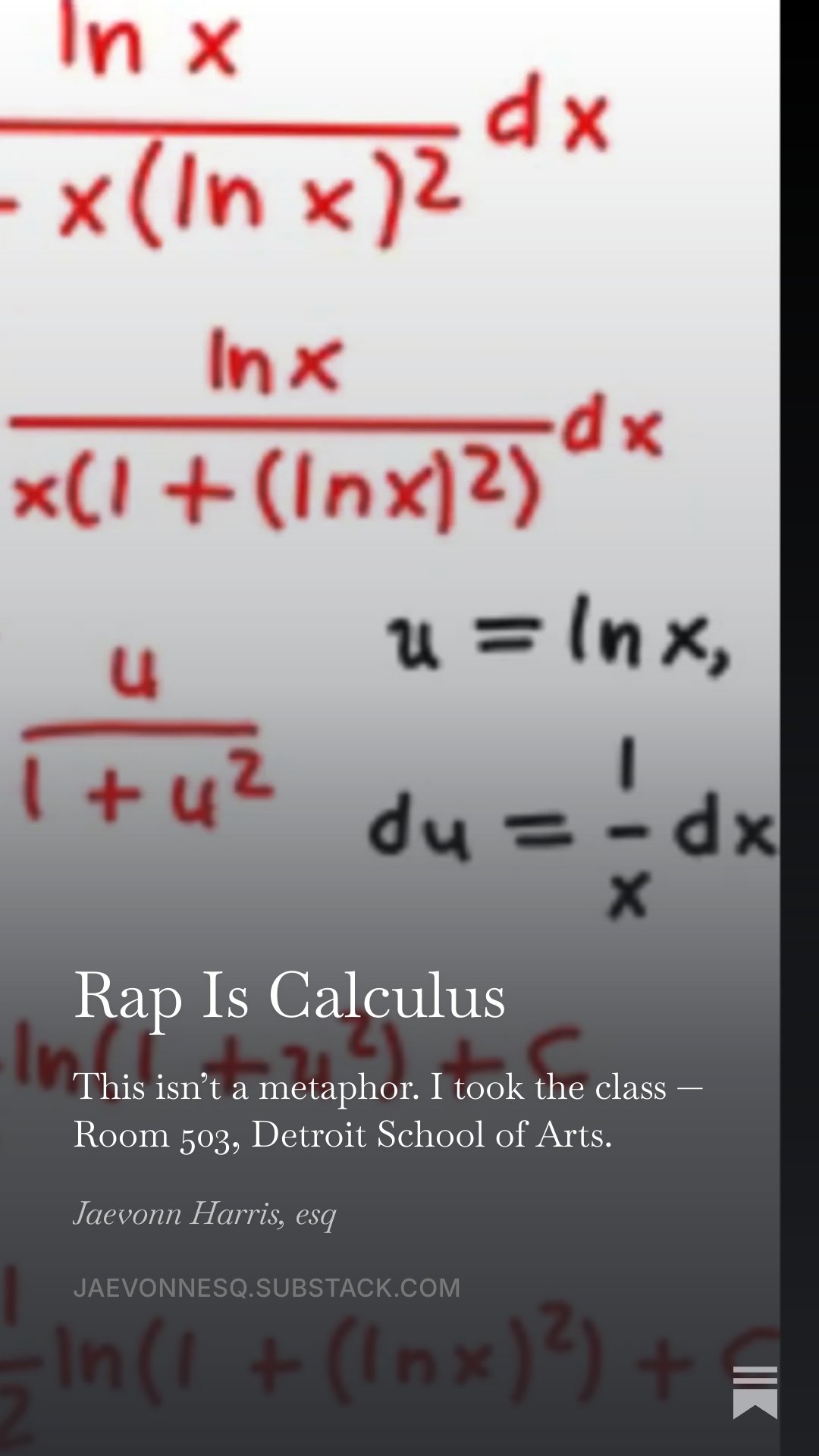
I’m not saying that to sound deep. I’m saying it because I did it. Senior year, Detroit School of Arts, Mrs. Gibson’s AP Calculus, Room 503, the ‘09-into-’10 school year — the same building where I was already filling the margins with raps.
Here’s what got me. I dug up that old syllabus, and the course description reads like the outline for this whole essay: understand the derivative in terms of rate of change, understand the meaning of the definite integral, represent differential equations. I was being handed the exact language for what I was already doing on the page every night — I just didn’t know yet that the two were the same thing.
So when I tell you to study calculus, it’s not so you can pass a test or put “STEM” in your bio. It’s because calculus is the math of change — and change is the only thing rap is actually made of.
Most people think rap is about words that rhyme. That’s the surface. Rap is about time — pushing language against a grid, deciding when tension builds and when it breaks. Rhyme is just the variable you can see. Everything that actually matters is moving underneath it. That’s calculus. Mrs. Gibson just called it something else.
Here’s the whole class, mapped onto the pen
.
A Derivative Is Just Your Cadence
A derivative measures how fast something is changing right now. Velocity is the derivative of position — not where you are, but how fast you’re moving through it.
On the page, the written line is your position. The delivery is the derivative. Two rappers can write the identical bar and only one of them has flow, because flow was never the words. It’s the rate you move through them.
Sorry never been a race I’m running at my own pace
That’s off Active Ting, and the whole couplet is about controlling your rate. I decide how fast I move through the line — and that decision is the flow. Take that exact bar and drag it slow and mopey and it dies on the beat. Same position on the page, different derivative in the air. Delivery is the math you feel before you can name it.
A Verse Is an Integral
An integral adds up a million tiny pieces into one big thing. No single moment carries it — the whole is the sum.
Watch a verse do it in real time:
Turn a dollar into ten that’s what you call a flip [...] And then miles add up, it’s time to take another Turn 50 into 100 that’s what you call a double up Put me in the pot And I bet I start to bubble up
A dollar isn’t the point. Ten isn’t the point. The sum is. Each bar is one thin slice, and the verse integrates them until you stop hearing numbers and start feeling momentum — miles adding up, a dollar bubbling into a hundred. That’s why you can’t quote a real verse in one line and expect somebody to feel it. They had to sit through the accumulation.
A Song Is a Differential Equation
A differential equation describes a system evolving through time. Where you are and how you’re changing are two different things.
A song is that system — and so is the life moving through it. I said it plain years back on Save the Youth, off First of His Name:
Instill patience and teach ‘em how to grow with time
Growth with time. That’s a rate of change written into a bar before I had the vocabulary for it. A differential equation never tells you where you’ll land; it gives you the rule for how you move from right here. A good song works the same way. You don’t write the destination — you write the rule of change and let the verse evolve under it. That’s the whole reason a project like the Spidey Pack could pick up a state I set down years earlier and keep solving it forward.
The Pocket Is a Partial Derivative
A partial derivative freezes the whole system, moves one variable, and watches what shifts.
In a track with a thousand moving parts, the pocket is you holding the beat dead still and moving only your placement.
Kid trauma in adult space, tryna keep up with adult pace.
Hold the meaning. Hold the beat. Slide one internal rhyme a hair — space, pace. That tiny slide is the whole difference between on-beat and in-the-pocket. Everything else stays constant. You changed one variable and the bar started breathing.
Editing Is a Gradient
A gradient points in the direction that changes something fastest. A writer who sees every angle at once is really just running that calculation:
Eyes in the back of my head No angle I can’t see
That’s off Up, Up, and Away. Seeing all the directions is step one. The gradient is choosing the steepest one — and when a bar is almost there, editing is exactly that: not rewriting everything, just finding the single move with the biggest payoff.
Every Bar Is Constrained Optimization
Optimization is the best answer under constraints. You never get infinite room. You get meter, breath, rhyme, and meaning, all fighting each other at once, and the craft is the most truth that survives all four.
Moves are calculated Everything we do precise
I wrote that on Hella Wavy and didn’t catch the pun until right now — calculated. Four words holding the whole principle. Meter, breath, rhyme, and meaning are all fighting each other for the same space, and the optimum is the most truth that survives all four at once. Cut a word, it breaks. Add a word, it breaks. Every bar you’ve ever loved is sitting on that exact edge — the calculated point where you can’t do better without giving something up.
Stop Collecting Punchlines. Start Hearing Change.
Don’t study rap like a bag of hot lines to memorize. That’s memorizing formulas. Do the real work:
Map your rhyme scheme on paper — see the structure with your eyes. Say the bar out loud until the pocket lives in your body, not your notes. Write the same idea five different ways and feel which derivative hits. Rebuild a bar you love from scratch so you learn why it works. Then tie all of it back to breath and the head-nod, because that nod is the grid everything moves against.
Mrs. Gibson’s rule was two hours of study outside class for every hour we spent in it. The pen charges the exact same tax. Nobody skips the work and keeps the flow.
Save the Youth in 2018, Active Ting, Hella Wavy, the Spidey Pack in 2026 — eight years of records and it’s the same math the whole way through. I wrote No Way Home during the theatrical run years ago and rebuilt it at 6am the morning Brand New Day hit theaters. Same DNA, years apart — because once you understand the change underneath a song, you can run it again in a brand new suit.
Rap gets beautiful the second you stop seeing words that rhyme —
and start hearing tension move through time.
Kid trauma in adult space Like you just took a hulk punch to the face It’s a new world out there for me to face Freedom in a swing — can I get a taste
Sun’s out. Mask’s on. Go study.
Visit gettothecorner.com
Follow me on x.com/onlyonejaevonn